
Industrial Fans vs Commercial – Which Is Better
No standard defines an industrial fan. The Department of Energy defines a fan or blower in federal code, and AMCA certifies how much air a fan actually moves. Neither one certifies the word industrial.
That leaves the label to the seller. A ceiling fan and a roof exhauster can both carry it, so comparing grades tells you almost nothing. Comparing duty tells you everything.
Five things change between a commercial fan and an industrial one. You can check every one of them on a nameplate or a spec sheet before you buy.
Already know your duty point? Call and we will spec against it. Still comparing? The five checks are below.
Have questions about which one is best for your application?
Need a quote?


Check out a comprehensive article about understanding centrifugal fans.
Are industrial fans better than commercial fans
Yes, industrial fans are better than commercial fans for continuous duty. An industrial fan runs 24 hours a day in dirty or hot air. A commercial fan is built for short runs in clean air. Above 6 inches water gauge of static pressure, commercial models stop being an option at all.
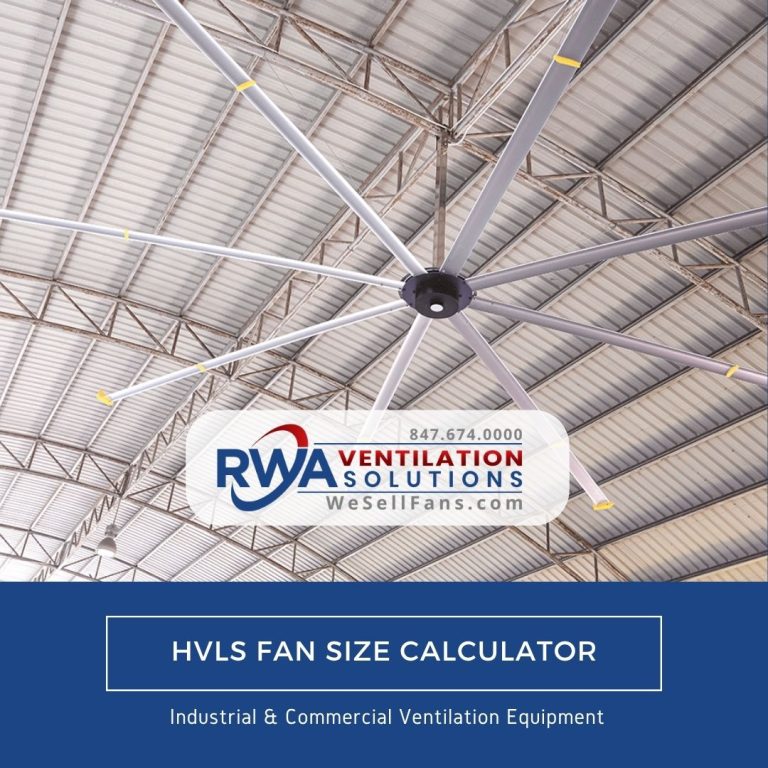
The label covers very different equipment. A 24-foot HVLS ceiling fan and a rooftop grease exhauster are both sold as industrial fans.
Four answers decide which one you need.
- Annual run hours
- What is in the air, from clean to grease, dust, or salt
- Inlet air temperature
- Whether you can reach it to service it
What makes a fan industrial grade
A fan is industrial grade when five specific things on it are upgraded. The table below names all five. Check them against a nameplate or a catalog page, and you will know what you are buying before the order goes in.
| What to check | Commercial | Industrial | Where to find it |
|---|---|---|---|
| Motor enclosure | ODP | TEFC | Nameplate, ENCL |
| Insulation class | Class B, 130°C | Class F 155°C or H 180°C | Nameplate, INSUL CLASS |
| Service factor | 1.0 | 1.15 | Nameplate, SF |
| Bearings | Sleeve, unrated | Ball, published L10 hours | Spec sheet |
| Air performance | Manufacturer claim | AMCA certified seal | Catalog |
The bearing row matters most. Across the EPRI and IEEE-IAS motor reliability surveys, bearings caused 41 to 51 percent of all failures. A published L10 hour rating is the only one of the five that tells you when the fan will stop.
Corrosive air changes the answer. Salt, chlorine, and fume streams eat coated steel, so those applications move to FRP fans instead of an upgraded motor.
How to get the selection checked
You do not have to run the five checks alone. Run hours, air stream, temperature, and access decide the selection, and the answer is rarely the same fan twice.
We do not build fans. Carrying several manufacturer lines means the recommendation can follow your application. Some jobs land on a stock axial. Others need FRP or a heavier bearing package.
Every unit ships with the manufacturer’s warranty.
Send the fan you are already looking at, or just the duty point. We will tell you where it lands on the five checks, and what changes if the air gets hotter or dirtier. Call 847-674-0000.
- Squirral Cage Fan
- Bitcoin Mining Equipment
- CNC Mist collector - Time to upgrade?
- Restaurant Air Curtains - Are they worth it?
- Direct Gas-Fired MUA - Efficent Heating Solution
- Rooftop Make Up Air Units - Is it the right choice?
- Industrial Dampers - Which one is right for your application?
- Industrial Air Curtains - Are they enough for heavy duty applications?
FAQ
How long should an industrial fan last?
An industrial fan lasts as long as its bearings, which is what the L10 rating measures. L10 under ISO 281 is the hour count at which 90 percent of identical bearings are still running. Median life lands near five times that number. Ask for L10 at your speed and load.
Do industrial fans have to meet an efficiency standard?
Industrial fans do not have to meet a federal efficiency standard today. The Department of Energy proposed one in January 2024 and withdrew it before it took effect. Model energy code sets the real floor. ASHRAE 90.1-2022 requires a Fan Energy Index of 1.00 or higher, calculated per ANSI/AMCA 208.
Are HVLS fans industrial fans?
HVLS fans are industrial fans, but they cover only one duty. NFPA 13 defines an HVLS fan as a ceiling fan roughly 6 to 24 feet in diameter, turning slowly to destratify a space. They do not develop static pressure, so ducted or exhaust duty needs an axial or centrifugal fan.