
Volume Control Dampers for HVAC Airflow Control
A volume control damper that misses its leakage class can fail a submittal review. ASHRAE 90.1 caps motorized damper leakage at 4 cfm per square foot at 1 inch w.g. IECC 2021 sets the same limit on outdoor air and exhaust openings.
Those numbers decide which damper you can spec. Blade style, frame material, and pressure rating decide whether it holds the setting once the system runs.
Getting one of them wrong costs a resubmittal. Getting the sizing wrong costs a damper that never controls, whistles at design flow, or sits near closed for the life of the building.
Need a price? Have questions?
What is VCD in HVAC?
A volume control damper (VCD) is a multi-blade damper installed in HVAC ductwork to regulate how much air reaches each branch or zone. Manual models hold their setting with a locking quadrant, and actuated models tie into the building control system. Both modulate airflow rather than provide tight shutoff or fire protection.
Key Takeaways
Volume dampers cover a wide range of duct configurations. Match the damper to the duct shape and the control method before you look at construction options.
| Damper Type | Where It Fits | Control Method |
|---|---|---|
| Rectangular multi-blade | Trunk and branch duct, low to medium pressure | Manual quadrant or actuator |
| Round volume damper | Round and flexible duct runs | Manual quadrant with position markings |
| Butterfly damper | Small round duct and tight installations | Single blade, manual or actuated |
| Zone damper | Zoned systems under automatic control | Actuator tied to the control system |
| Balancing damper | Air balance work, set once and locked | Manual, remote, or automatic |
| Bubble tight isolation | Full shutoff, not modulation | Actuated, near zero leakage |
| Corrosive duty | Fume and chemical exhaust | Manual or actuated, FRP or coated |
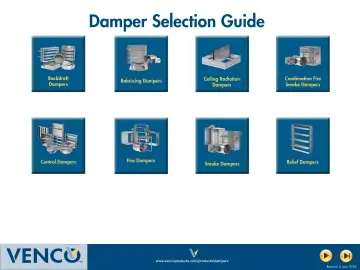
Interactive PDF Guide for a Variety of Dampers in HVAC
Damper Leakage Classes and What Codes Require
Damper leakage class tells you how much air still passes through the damper when it is fully closed. AMCA sets four classes, measured at 1 inch w.g. Class 1A is the tightest and allows 3 cfm per square foot. Class 3 is the loosest and allows 40.
Leakage class is one of the first numbers a reviewer checks on your submittal. If the damper leaks more than the code allows, the package comes back to you for revision. The table below shows the limit for each class.
| Leakage Class | Max Leakage at 1 in. w.g. | Max Leakage at 4 in. w.g. |
|---|---|---|
| Class 1A | 3 cfm/ft² | Not defined |
| Class 1 | 4 cfm/ft² | 8 cfm/ft² |
| Class 2 | 10 cfm/ft² | 20 cfm/ft² |
| Class 3 | 40 cfm/ft² | 80 cfm/ft² |
Energy codes go one step further. They name a specific class for each type of opening, and the three below cover most commercial projects.
| Code | Damper Leakage Requirement |
|---|---|
| ASHRAE 90.1-2019 | Motorized 4 cfm/ft², non-motorized 20 cfm/ft², at 1 in. w.g. |
| IECC 2021 | Class 1 motorized dampers on outdoor air and exhaust openings |
| California Title 24-2019 | AMCA 511 certified, 10 cfm/ft² max at 1 in. w.g., after 60,000 cycles |
AMCA 511 matters here. It means an independent lab tested the damper and confirmed the leakage number. The manufacturer did not simply publish its own figure. If you are specifying a damper for an outdoor air or exhaust opening, contact us and we will send you the certified rating.
Opposed or Parallel Blades for Volume Control
Opposed blade dampers give you finer control of airflow. The blades sit next to each other and rotate in opposite directions, so the air splits evenly down the middle of the duct. Parallel blades all rotate the same way, which pushes the air toward one side of the duct.
The right choice depends on what the damper has to do once the system is running.
Two simple rules cover almost every case.
- Choose opposed blades when the damper needs to hold airflow at a set point somewhere between fully open and fully closed.
- Choose parallel blades when the damper only needs to open all the way or close all the way.
Size matters as much as blade style. Many dampers get ordered to match the duct size, which sounds sensible but leaves the damper nearly closed all the time.
A small nudge of the blades then causes a big jump in airflow, and the setting will not hold. Send us the airflow you need and we will size the damper around it.
Balancing Damper or Volume Control Damper
A balancing damper and a volume control damper often look the same and use the same parts. The difference is the job each one does.
A balancing damper gets set once during air balance and then locked in place. A volume control damper keeps moving, either by hand or by actuator, as the building’s demand changes.
The deciding question is simple. Ask what the damper has to do once the building is open and running. Set it once during air balance and leave it alone, and you want a balancing damper.
If the damper has to keep adjusting airflow all day, the volume control dampers on this page are built for that.
Damper Guides and Specification Sheets
The documents below are hosted on this site, with no form to fill out and no login to clear. Pick a manufacturer, then open the sheet that matches your schedule.
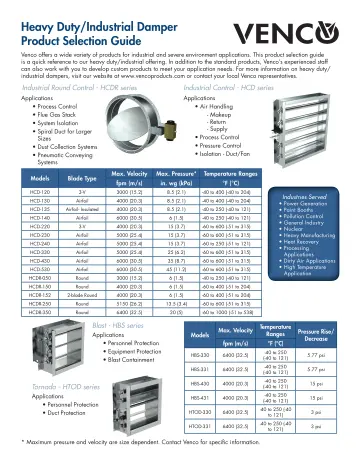
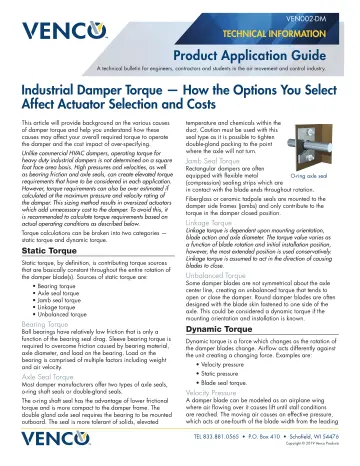
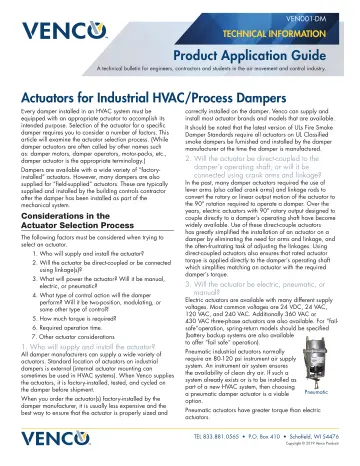
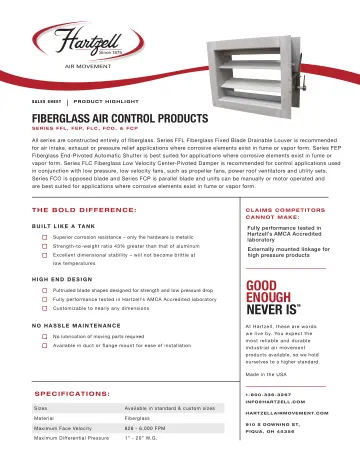
 Product Comparison Guide
Twelve pages across the damper line
 CD-75, CD-76
Thinline extruded aluminum, low leakage
 CD-100, CD-101
Extruded aluminum, to 3 in. w.g. Meets 3 cfm/ft² at 1 in. w.g. with seals
 CD-110, CD-111
Rollformed steel, 16 gauge blades, to 8 in. w.g.
 CD-120, CD-121
Heavy duty steel blade, to 12 in. w.g.
 CD-145, CD-146
Airfoil blades within the frame, 6 cfm/ft² at 4 in. w.g.
 CD-150, CD-151
Extruded aluminum airfoil, ultra low leakage
 CD-160, CD-161
Galvanized hat channel frame, airfoil blade
 CD-170, CD-171
Galvanized steel airfoil with AMCA leakage class data
 Model RI
Round, double skin galvanized blades, with seals


Volume Control Damper Questions
Plain answers on choosing, placing, and specifying volume dampers.
Call 847-674-0000 with anything specific to your job.
Yes, when the duct both crosses a fire-rated barrier and needs airflow control. A fire damper is a life safety device rated to UL 555 and closes on heat. A volume control damper regulates airflow and carries no fire rating. Neither one substitutes for the other.
A VAV box is a terminal unit with its own flow sensor, controller, and often a reheat coil. It varies supply air to a zone automatically as demand changes. A volume control damper is the damper alone, with no flow measurement and no logic of its own.
A plenum damper controls the air leaving a supply or return plenum into the branch duct it feeds. Most are round with a manual quadrant. Position markings on the quadrant let you record the setting and return to it after service work.
Install the damper in a straight run of duct, far enough from elbows and takeoffs that the airflow reaching it is stable. Turbulent air entering a damper makes the setting drift and the blades noisy. Leave clear access to the quadrant or actuator so the balancing contractor can reach it later.