

Indirect vs Direct Fired Make-Up Air
Indirect and direct fired make-up air both heat outside air, but they burn gas in different places.
An indirect fired unit burns gas inside a sealed heat exchanger and vents combustion products out a flue. A direct fired unit burns gas right in the airstream. Choose indirect when burner exhaust can never reach the space.
Choosing the right configuration is the harder part. Problems come from the wrong heat exchanger, too little turndown, or a cabinet that does not fit the curb.
All three show up late, after the order is placed. We spec these units across several manufacturer lines, so the equipment matches the application instead of one brand’s lineup.
Tell us how much air you exhaust and what happens inside the space, and we will size it and send you a proposal.
Have questions about Indirect Gas-Fired MUA Units?
Need a quote?
Indirect Make Up Air Units for Sale
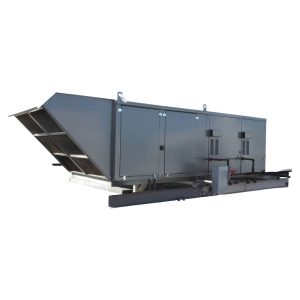
Indirect Make-up Air Application Gallery


Where Indirect Fired Beats Direct Fired
A direct fired unit burns gas right in the airstream. An indirect fired unit keeps the flame sealed, so nothing from combustion reaches your space.
If people work there all shift, if product sits exposed, or if extra moisture causes trouble, indirect is the safer pick.
| Your building | Direct fired | Indirect fired |
|---|---|---|
| People in the space all shift | Workable with controls | Preferred |
| Exposed product or sensitive process | Not suitable | Required |
| Added moisture causes problems | Adds water vapor | Adds none |
| Recirculating part of the return air | Limited | Standard |
| Open industrial space, heat only | Strong choice | Usually unnecessary |
Food plants, pharmaceutical suites, and paint areas almost always land in the indirect column.
Configurations and capacities are on our indirect fired make up air unit page.
Airflow, Turndown, and Building Pressure Control
Airflow and turndown decide whether the unit holds its discharge temperature when the load drops. A unit sized only for design day will short cycle in mild weather. We spec to the range your exhaust actually runs, and we set the controls so the building stays where you want it.
| What we configure | Options |
|---|---|
| Airflow | 600 to 200,000 CFM |
| Heating input | Up to 20,000,000 BTU |
| Heat exchanger | Aluminized steel, 409 or 316 stainless |
| Cooling | DX, chilled water, evaporative, or ammonia |
| Fuel | Natural gas or LP |
| Air source | 100% outside air or recirculating |
| Volume control | Constant volume or VAV |
| Burner control | Full modulation for a steady discharge temperature |
| Control signal | Discharge temperature, building pressure, or space temperature |
| Cabinet | Single or double wall, indoor, outdoor, or rooftop |
Building pressure control only works when the relief path matches the supply.
We size backdraft dampers and relief openings on the same call, which matters most in manufacturing plants running heavy process exhaust.
Indirect vs Direct Fired Make-Up Air Questions
Plain answers on comparing, choosing, and certifying indirect fired make-up air.
Call 847.674.0000 with anything specific to your job.
Direct and indirect fired make-up air differ in where combustion happens. A direct fired unit burns gas in the supply airstream, so combustion products enter the space. An indirect fired unit burns gas inside a heat exchanger and vents combustion products outdoors through a flue.
Direct fired make-up air is more efficient, because nearly all of the burner's heat goes into the supply air. Indirect fired units typically run around 80% thermal efficiency, since some heat leaves with the flue gases. The trade is clean supply air.
Indirect fired make-up air units are typically certified to ANSI Z83.8, the standard for gas-fired duct furnaces and packaged heaters. Direct fired units fall under ANSI Z83.4, which covers 100% outside air, and ANSI Z83.18 for recirculating designs.