
Warehouse Ventilation Systems
If your warehouse runs hot in summer, your exhaust fans aren’t keeping up, or you’re not sure what ventilation equipment your building needs, you’re in the right place.
RWA has been sizing and recommending commercial and industrial warehouse ventilation systems for over a century.
As authorized distributors for Hartzell, Hunter, AirPro, and other top US-based manufacturers, we recommend the right warehouse exhaust fan or ventilation system for your situation, not whatever happens to be in stock. Every product ships with the manufacturer’s full warranty.
Below, we cover sizing, exhaust, and makeup air balance, and which fan type fits your problem.
Have a question? Need a quote for a warehouse exhaust fan?
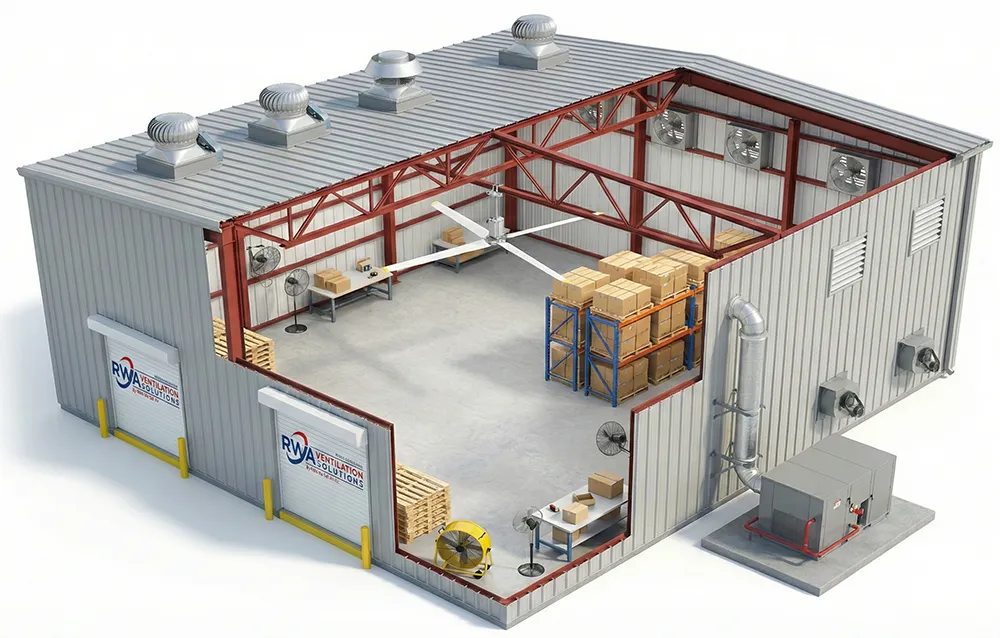
Use this table to find the right section for your warehouse ventilation project. Each takeaway links to the details you need.
Click on any takeaway to jump directly to the specific details for that topic.
| Key Takeaways | Actionable Insights |
|---|---|
| Size Your System Correctly | Undersized systems leave hot spots. Oversized systems waste money. Use our CFM tables to calculate what your building actually needs. |
| Balance Exhaust and Makeup Air | If doors are hard to open or exhaust fans underperform, you have a pressure problem. Learn when louvers are enough and when you need a makeup air unit. |
| Choose the Right Fan Type | HVLS fans fix stratification. Exhaust fans remove heat and fumes. Drum fans cool specific workstations. Match the equipment to the problem. |
| Control Airflow with Louvers and Dampers | Undersized louvers choke your fans. Size them for no more than 500 FPM to keep airflow high and rain out. |
How to Size a Warehouse Ventilation System
Every warehouse ventilation project starts with one question.
How much airflow do you need?
Undersize your system and you get hot spots, stale air, and workers who slow down when temperatures climb. Oversize it, and you’re paying for equipment and energy you don’t need.
Minimum CFM by Zone Type
| Zone Type | CFM per Square Foot | CFM per Person |
| General storage | 0.06 | 10 |
| Shipping and receiving | 0.12 | 10 |
| Sorting and packing | 0.12 | 7.5 |
Shipping areas need double the airflow of storage areas. Forklift exhaust, dock door traffic, and physical activity all generate heat and contaminants.
View the homepage for Industrial Ventilation Equipment for more information

Warehouse Exhaust Fans: Types and Benefits
- Warehouse Exhaust Fan
- Intake fans
- Natural Ventilation
- Ductwork
- Air Curtains
- Commercial Floor Fan
- Pedistool Fan
- Make-Up Air Units
- HVLS Fans
- Blower Fans
- Drum Blower Fan
- UV-C Disinfection Lights
- Dampers
- Louvers
Air Changes Per Hour by Activity Level
| Activity Level | Target ACH |
| Storage with minimal activity | 6–8 |
| Active work zones with forklifts | 10–15 |
| Areas with fumes, dust, or heat-generating equipment | 20+ |
ACH measures how fast you replace the entire air volume in the space. Higher ceilings mean you need more CFM to hit the same ACH.
Quick Reference for Common Warehouse Sizes
| Square Footage | Ceiling Height | CFM for 10 ACH |
| 25,000 sq ft | 24 ft | 100,000 CFM |
| 50,000 sq ft | 30 ft | 250,000 CFM |
| 100,000 sq ft | 36 ft | 600,000 CFM |
These numbers assume the full space needs active ventilation. If only part of your warehouse runs hot or handles fumes, you may need less total CFM.
Not sure what your building needs?
Call us with your square footage and ceiling height. We’ll help you figure out what your system should deliver.
How to Balance Exhaust and Makeup Air in Your Warehouse
A warehouse exhaust fan removes air from your building. That air has to come from somewhere. If you don’t control where replacement air enters, your building pulls it through every crack, seam, and dock door opening it can find.
This is called negative pressure. You’ll feel it when doors are hard to open, when drafts shoot through entryways, or when your industrial exhaust fans aren’t moving the air volume they’re rated for.
Signs Your Warehouse Has a Pressure Problem
| Symptom | What’s Happening |
| Doors hard to push open or slam shut | Building pressure is fighting against you |
| Warehouse exhaust fans underperforming | Fans can’t pull air out because nothing is coming in |
| Cold drafts at dock doors in winter | Uncontrolled air rushing in through openings |
| Higher heating and cooling bills | You’re conditioning random outside air instead of controlled supply |
The fix is straightforward: supply air should roughly match exhaust air. For every CFM your exhaust fans for warehouse applications pull out, you need to bring roughly that much back in.


When Intake Louvers and Natural Airflow Are Enough
Smaller warehouses under 20,000 square feet with moderate exhaust loads can sometimes rely on wall louvers and natural infiltration. If dock doors open frequently throughout the day, that movement may supply enough replacement air.
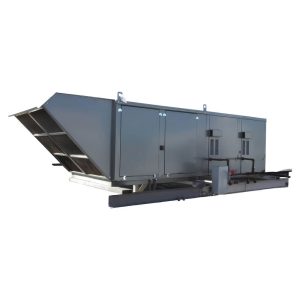
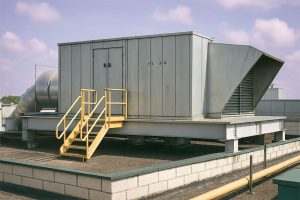
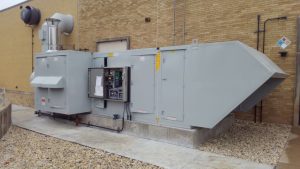
When You Need a Makeup Air Unit
| Situation | Why a Makeup Air Unit Solves It |
| Total exhaust exceeds 10,000 CFM | Louvers and gaps can’t keep up with that volume |
| Tight building construction | Modern buildings don’t leak enough air passively |
| Temperature control matters | Unfiltered outside air creates hot or cold zones |
| Exhausting fumes, dust, or welding smoke | High-volume exhaust systems need matched supply |
A makeup air unit brings in outside air, filters it, and heats or cools it before pushing it into the space. Your warehouse exhaust fans work at full capacity because they’re not fighting pressure. Your heating and cooling systems use less energy because you’re controlling the air entering the building.
If your exhaust fans aren’t performing or you’re dealing with pressure problems at dock doors, makeup air is likely the missing piece.
Which Warehouse Fan Type Solves Which Problem
The right warehouse ventilation fan depends on what you’re trying to fix.
Below we break down each application, the equipment that solves it, and how to size it.
Circulating Stagnant Air in High-Ceiling Warehouses
If your warehouse has ceilings above 20 feet and workers complain about dead air or temperature differences between floor and ceiling, you have a stratification problem.
Hot air rises and stays trapped at the top. Cool air pools at the floor.
The result is wasted heating in winter and hot workers in summer, even when the AC is running.
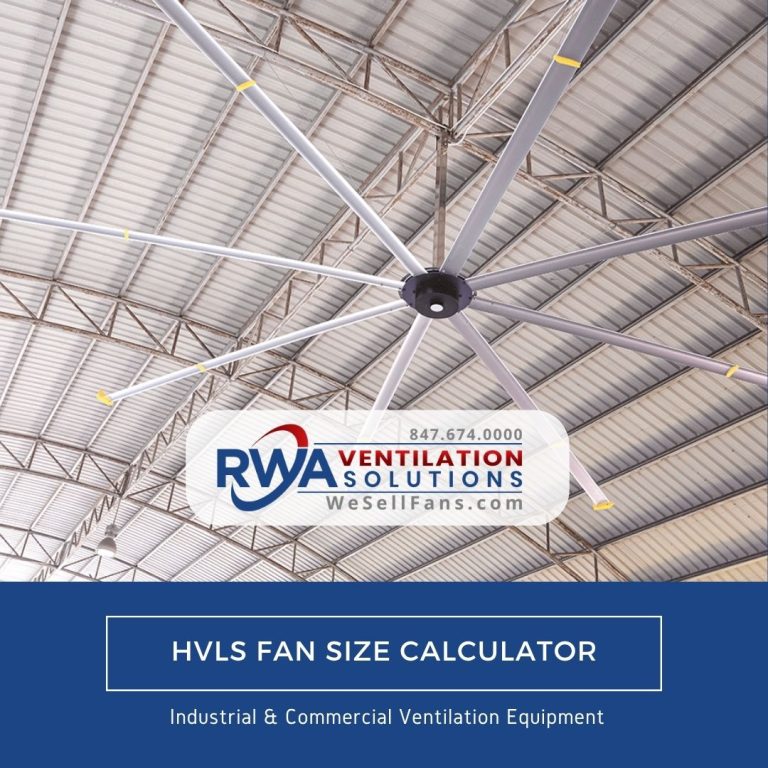
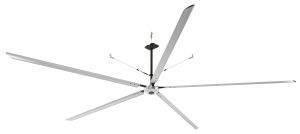
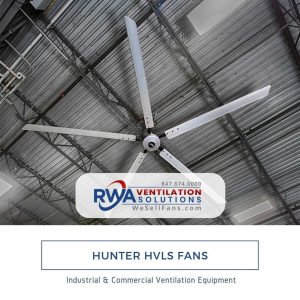
HVLS fans, sometimes called big fans for warehouses, solve this by moving large volumes of air slowly enough that workers don’t feel a harsh wind. They keep air circulating from floor to ceiling, keeping temperatures consistent throughout the space.
One 24-foot HVLS fan covers 15,000 to 20,000 square feet and draws about 1.5 kW. To cover the same area with floor fans, you’d need 8 to 10 units pulling over 10 kW combined. For any warehouse over 10,000 square feet, HVLS wins on energy cost and coverage.
View all HVLS fans here.
Warehouses HVLS Fans for Sale
Removing Hot Air and Fumes from Your Warehouse
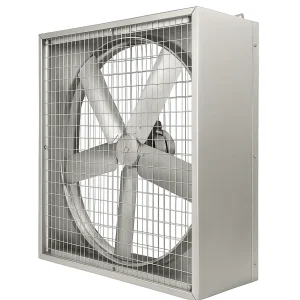
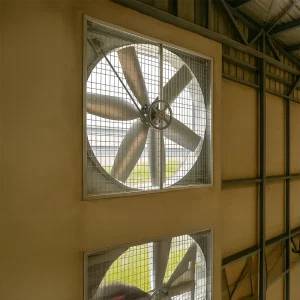
When heat builds up at the roofline, fumes linger from equipment, or air quality drops in enclosed areas, you need to move that air out of the building. This is the job of warehouse exhaust fans.
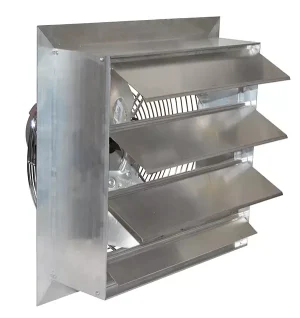
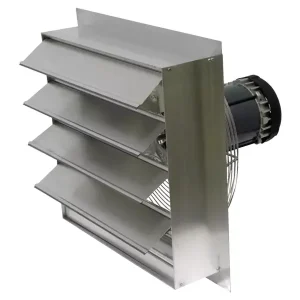
Wall-mounted propeller exhaust fans are the most common choice for warehouse exhaust. They move large volumes of air efficiently and mount easily through an exterior wall. Most come with shutters or weather hoods to protect against rain and backdrafts when the fan is off.
| Exhaust Fan Type | Best Application | Mounting Location |
| Wall-mounted propeller fans with shutters | General warehouse exhaust, heat removal, maintaining air change rates | Exterior wall, high placement |
| Hooded roof exhaust fans | Weather protection in harsh climates, rain and snow resistance | Roof curb with protective hood |
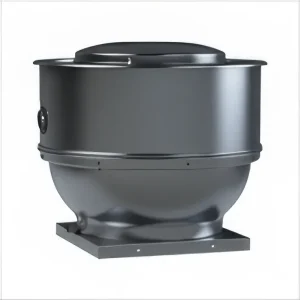
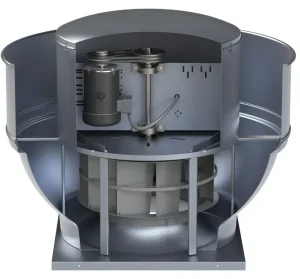
| Upblast roof exhaust fans | High-volume exhaust, areas with light fumes or dust | Roof penetration, discharges upward |
Sizing depends on the CFM and ACH targets in the sizing section above.
Bringing Fresh Air Into the Building
Exhaust fans pull air out. Something has to bring air in. If you’re relying only on gaps and open dock doors, you’re not controlling where that air comes from or what condition it’s in.
Wall supply fans push filtered outside air into the warehouse. They’re typically mounted on the opposite wall from your exhaust fans to create cross-ventilation. This moves air through the entire space instead of letting fresh air get pulled right back out near the exhaust.
| Equipment Type | Use Case |
| Wall supply fans | Active air intake for larger buildings or where passive airflow can’t keep up with exhaust volume |
| Filtered intake systems | When outdoor air carries dust, pollen, or debris |
| Tube axial fans | Ducted supply systems or when air needs to travel through ductwork before entering the space |
For most warehouse ventilation systems, position supply fans low on the wall and exhaust fans high on the opposite wall. Cool air enters low, warms as it rises, and exits through the exhaust. This takes advantage of natural convection instead of fighting it.
[Link to Supply Fans] [Link to Tube Axial Fans]
Controlling Airflow with Louvers and Dampers
Fans move air. Louvers and dampers control where it goes and when.
| Component | Function | Where It Goes |
| Intake louvers | Weather protection, debris screening | All wall intake openings |
| Exhaust louvers | Weather protection, prevents backdraft when fan is off | Wall-mounted exhaust fan openings |
| Backdraft dampers | Prevent reverse airflow when fans are off. Cheap insurance on every installation. | Inline with exhaust and supply fans |
| Volume control dampers | Adjust airflow to zones | Ductwork or at fan discharge |
| Fire dampers | Close automatically to prevent fire spread through ductwork | Ductwork penetrations through fire-rated walls or floors |
Louvers need to be sized for the airflow passing through them. Undersized louvers restrict airflow and reduce fan performance. A common rule is to size louvers so air passes through at no more than 500 feet per minute. This keeps resistance low and reduces rain from getting pulled in.
Spot Cooling for Workstations and Packing Areas
Sometimes the problem isn’t building-wide. It’s a specific workstation, packing line, or shipping desk where workers spend hours in one spot and need direct airflow.
HVLS fans and exhaust systems won’t solve this. You need targeted air movement from drum fans, pedestal fans, or mounted air circulators.
| Fan Type | Coverage | Best For |
| 48-inch drum fans | Directed airflow up to 100 ft | Shipping areas, loading docks, temporary cooling |
| Pedestal fans | Single workstation | Packing stations, inspection areas |
| Wall-mounted air circulators | Fixed work zones | Assembly lines, processing stations |
A 48-inch drum fan draws about 1 kW and moves enough air to keep a small crew comfortable at a packing station. They’re not efficient for cooling an entire warehouse, but they’re the right tool when the problem is one hot spot, not the whole building.
Not Sure Which Warehouse Ventilation Equipment You Need?
Every warehouse is different. Ceiling height, square footage, what you’re storing, how often dock doors open, and whether you’re dealing with fumes or just heat. All of it affects what you need.
RWA Ventilation Solutions has been helping facility managers figure this out for over a century. Tell us what’s going on in your building, and we’ll recommend the right equipment.
Call 847-674-0000 or request a quote below.

Scott Williamson
Scott Williamson specializes in warehouse ventilation systems. His expertise has been featured in HubSpot and Tech Bullion.